How to write better rental listings, improve online visibility, and attract qualified tenants in the San Gabriel Valley.
Finding a qualified tenant starts with making sure prospective renters can find your property. But the way people search for rental homes and apartments is changing.

Traditional rental searches often involve browsing listing websites, selecting a city, setting a price range, and comparing available properties. Today, renters can also use conversational searches and AI-powered tools to ask more specific questions, such as:
- Which apartments in Alhambra allow cats and include covered parking near Main Street?
- Are there two-bedroom rentals in Pasadena with in-unit laundry near Caltech or the Metro A Line?
- What single-family homes are available for rent near Old Town Monrovia?
- Which rental properties in West Covina have private garages near the I-10 corridor?
These searches create new opportunities for rental properties to be discovered through search engines and AI-powered search experiences.
For San Gabriel Valley landlords looking to attract high-quality tenants, an effective rental listing needs to do more than describe a property as beautiful, spacious, or conveniently located. It needs to provide accurate, specific information that answers the questions prospective tenants are asking.
Although no one can guarantee that an AI assistant will recommend a particular rental, clear and consistent property information makes listings easier for both people and search systems to understand.
Here are 6 ways San Gabriel Valley landlords can improve their rental listings and adapt to changing search habits.
How AI Is Changing the Way Renters Find Properties
Renters have traditionally relied on real estate websites, rental listing platforms, and Google searches to find available properties. Those methods remain important, but AI-powered search experiences are adding another way to discover information.
Instead of entering a few keywords, renters can ask complete questions and narrow their search based on specific requirements.
For example, someone looking for a rental in the San Gabriel Valley might ask an AI assistant to find a two-bedroom apartment in Arcadia that allows pets, includes parking, and sits close to The Shops at Santa Anita or the Arcadia Metro A Line station.
To provide a useful answer, an AI-powered search tool needs access to relevant information about available properties.
That information may come from indexed websites and other accessible sources, depending on the platform. However, the exact methods used to select and recommend individual rental listings aren’t made public, and appearing in an AI-generated answer is never guaranteed.
Google’s own guidance emphasizes that traditional SEO fundamentals remain important for its AI-powered search features. Websites should be crawlable, useful, accurate, easy to navigate, and supported by clear, relevant content.
For landlords, the practical takeaway is simple: make your rental listing as informative and accurate as possible.
Why Specific Rental Descriptions Matter
Generic descriptions don’t give prospective tenants much information to work with.
Consider these two examples of how the same hypothetical apartment could be advertised.
- Before: “Beautiful two-bedroom apartment in a great location! Spacious, bright, and close to everything. This one won’t last long!”
- After: “Two-bedroom, one-bathroom apartment available for rent in Alhambra, California. Approximately 950 square feet with one covered parking space, central air conditioning, and washer and dryer hookups. Cats considered under the property’s pet policy. Monthly rent is $X, with tenants responsible for electricity and gas. Located 0.6 miles from downtown Alhambra’s Main Street dining and retail corridor and approximately 1.2 miles from Garfield Medical Center, with convenient access to the I-10 freeway. Available [move-in date].”
The second description answers questions that matter to prospective renters.
It identifies the property’s location, size, amenities, parking, pet policy, rental price, utility responsibilities, local landmarks, and availability. Those details also give search engines and AI-powered tools more meaningful information to interpret.
6 Ways to Improve Your Rental Listing for Google and AI Search
1. Include Specific Property Details
One of the easiest ways to improve a rental listing is to provide more complete information.
Prospective tenants want to know whether a property meets their needs before scheduling a showing. Missing details can cause qualified renters to overlook an otherwise suitable property—leading to longer downtime between tenants, which is one of the primary ways owners spot and fix cash flow leaks from extended vacancies.
Every rental listing should include:
- Monthly rental price and applicable fees
- Number of bedrooms and bathrooms
- Approximate square footage
- Parking availability and type
- Laundry facilities
- Heating and air conditioning
- Included appliances and amenities
- Pet policies and restrictions
- Utility responsibilities
- Lease duration
- Available move-in date
- Application requirements
Be especially clear about features that might influence a renter’s decision. If parking is limited to one assigned space, explain that. If laundry facilities are shared rather than located inside the unit, make that distinction.
Accurate information helps prospective tenants make informed decisions and reduces unnecessary inquiries from people whose requirements don’t match the property.

2. Describe the Location with Specific, Verifiable Information
Location is one of the most important factors in a rental decision, but phrases like “close to everything” and “minutes from shopping” don’t tell prospective tenants much.
Instead, identify nearby destinations across the San Gabriel Valley that renters actively search for:
- Employment centers and major business districts: Old Pasadena, Downtown Alhambra, or the Valley Boulevard commercial corridor in San Gabriel
- Shopping centers and grocery stores: Alhambra Place, The Shops at Santa Anita in Arcadia, or Plaza West Covina
- Hospitals and medical facilities: Huntington Hospital in Pasadena, USC Arcadia Hospital, Garfield Medical Center in Alhambra, San Gabriel Valley Medical Center, or Emanate Health Queen of the Valley Hospital in West Covina
- Public transportation stations: Metro A Line stations in Pasadena (Del Mar, Memorial Park, Lake, Allen), Arcadia, or Monrovia
- Major freeways and commuter routes: I-10, I-210, I-710, and I-605
- Parks and recreational facilities: Almansor Park in Alhambra, the Los Angeles County Arboretum in Arcadia, or Brookside Park in Pasadena
- Colleges and universities: California Institute of Technology (Caltech) and Pasadena City College (PCC)
For example, a rental in Alhambra might note its verified distance to Alhambra Place or Garfield Medical Center. A property in Monrovia might reference an exact distance to Old Town Monrovia along Myrtle Avenue or the Monrovia Metro A Line station, while a listing in Pasadena might cite proximity to Pasadena City College or Huntington Hospital.
Use actual driving, walking, or transit distances rather than making unsupported claims about travel times.
Be careful to distinguish between walking distance and driving distance. A property that is three miles from a shopping center isn’t necessarily within walking distance.
Specific location information makes a listing more useful to prospective tenants and provides additional geographic context for AI-powered search engines.
3. Add Frequently Asked Questions to Your Rental Listing Page
Many prospective tenants have the same questions before deciding whether to schedule a showing.
Rather than making people contact the property manager for every basic detail—and to support preventing landlord-tenant disputes through clear lease terms from day one—consider adding a short FAQ section to the property’s website listing.
Useful questions include:
- Are pets allowed? Explain the property’s pet policy, including any applicable restrictions and fees.* Remember that assistance animals are subject to different legal requirements than ordinary pets.
- Is parking included? Identify the number of available spaces and whether they are assigned, covered, enclosed, or available on a first-come basis.
- Which utilities are included in the rent? Specify which utilities are paid by the landlord and which are the tenant’s responsibility.
- What are the application requirements? Explain the application process, applicable fees, screening criteria, and any required documentation.
- How long is the lease? Identify the available lease term and explain whether renewal options are available.
- When is the property available? Provide an accurate expected move-in date.
Writing questions in the same conversational language renters use makes the information easier to navigate. It also creates useful content that can address specific search queries.
FAQ content is beneficial for people and can help clarify a property’s information, although adding an FAQ section does not guarantee special Google search features or AI visibility.
**Effective April 1, 2027: Under California’s SB 1296, the Pet Policy Transparency Act, landlords must provide written pet policy disclosures, including when pets are prohibited. These disclosures must be included with rental applications and made accessible through applicable online listings and rental search platforms. Assistance animals are subject to separate fair housing requirements and must not be treated as ordinary pets.
4. Keep Property Information Consistent Across the Web
Rental properties are frequently advertised in multiple places, including property management websites, rental portals, social media, and other online directories.
When information differs between these sources, prospective tenants (and AI) can become confused.
For example:
- One website lists the rent at $2,500, while another shows $2,600.
- The property website says pets are permitted, but the rental portal says no pets.
- One listing includes covered parking, while another doesn’t mention parking at all.
- A property is advertised as available even though a tenant has already signed a lease.
Establish a process for updating all advertising channels whenever important property information changes. This includes updating rental prices, availability, amenities, pet policies, and contact information.
Consistency is important for renters, search engines, and AI-powered search experiences alike.
5. Use High-Quality Photos and Rental Walkthrough Videos
**Important California photo disclosure update: Beginning January 1, 2027, California AB 2025 requires disclosures when digitally altered images are used in residential rental advertising, along with access to the original, unaltered images as specified by the law. This includes certain images modified or generated using artificial intelligence. The law excludes ordinary photographic adjustments that don’t change the representation of the property and includes an exception for leaseholds exceeding one year.
Even the most detailed rental description won’t do much good if the accompanying photos are poor.
Prospective tenants want to see what a property actually looks like before deciding whether to schedule a showing.
Use clear, current photographs that accurately represent the rental, including:
- Living areas and bedrooms
- Kitchens and bathrooms
- Closets and storage areas
- Laundry facilities
- Parking spaces and garages
- Outdoor spaces and common areas
- Important amenities
Consider adding a short walkthrough video to show how the rooms connect and how the property is laid out.
Videos can be shared on your website and social media accounts, giving prospective renters another way to evaluate the property before arranging a visit. InveServe offers additional guidance in our article on filming and posting rental property walkthrough videos on Instagram, TikTok, and YouTube.
Landlords and property managers should review the requirements before using virtual staging or AI-generated property images. See the California Department of Real Estate’s summary of 2026 real estate legislation.
6. Maintain Your Online Reputation and Business Information
Prospective renters—and investment property owners evaluating management partners—often research a company before submitting an application or arranging a showing.
Reviews, business information, and a professional online presence help establish credibility, which is also a key factor when choosing a San Gabriel Valley apartment manager.
Landlords and property managers should:
- Keep business contact information current.
- Maintain accurate office hours and service-area information.
- Respond professionally to online reviews.
- Correct outdated business information.
- Make sure the company website clearly explains its services.
- Provide an easy way for prospective clients to get in touch.
For property management companies serving the San Gabriel Valley, this includes accurately identifying the communities they serve, such as Alhambra, Arcadia, Monrovia, Pasadena, San Gabriel, West Covina, and surrounding areas where applicable.
Google Business Profiles and customer reviews are useful components of a company’s overall online presence. However, there is no guarantee that positive reviews or a particular profile configuration will cause an AI tool to recommend a specific rental property or management company.
The objective should be to establish a credible, accurate, and consistent online presence.
Using AI to Write Rental Listings: What Landlords Should Know
AI writing tools can help landlords and property managers create rental descriptions, organize property details, and develop answers to frequently asked questions.
They can save time, but AI-generated content should never be published without reviewing it. There are several important considerations:
- Verify every property detail. AI tools can generate convincing descriptions while inventing amenities, square footage, nearby attractions, or property features. Verify every detail against the actual property.
- Review language for Fair Housing compliance. The federal Fair Housing Act prohibits discriminatory housing advertisements based on protected characteristics, including race, color, national origin, religion, sex, disability, and familial status. Avoid language that suggests a preference for particular types of renters. For example, descriptions such as “perfect for young professionals” or “adults only” can raise Fair Housing concerns depending on the context. Describe the property and its features rather than the type of person you think should live there. For additional guidance, consult the U.S. Department of Housing and Urban Development’s Fair Housing advertising regulations.
- Check local rental regulations. Rental laws and regulations can vary between San Gabriel Valley communities—for instance, local rent stabilization ordinances in Pasadena operate differently from neighboring cities. Don’t rely on an AI tool to determine whether a particular rent increase, deposit, fee, or lease provision is legally permissible. Verify applicable requirements against current state and local laws.
- Don’t let AI exaggerate the property. An AI-generated description should accurately reflect the actual rental. Avoid adding amenities, upgrades, or neighborhood advantages that haven’t been verified.
AI is a writing assistant, not a substitute for accurate property information or professional judgment.
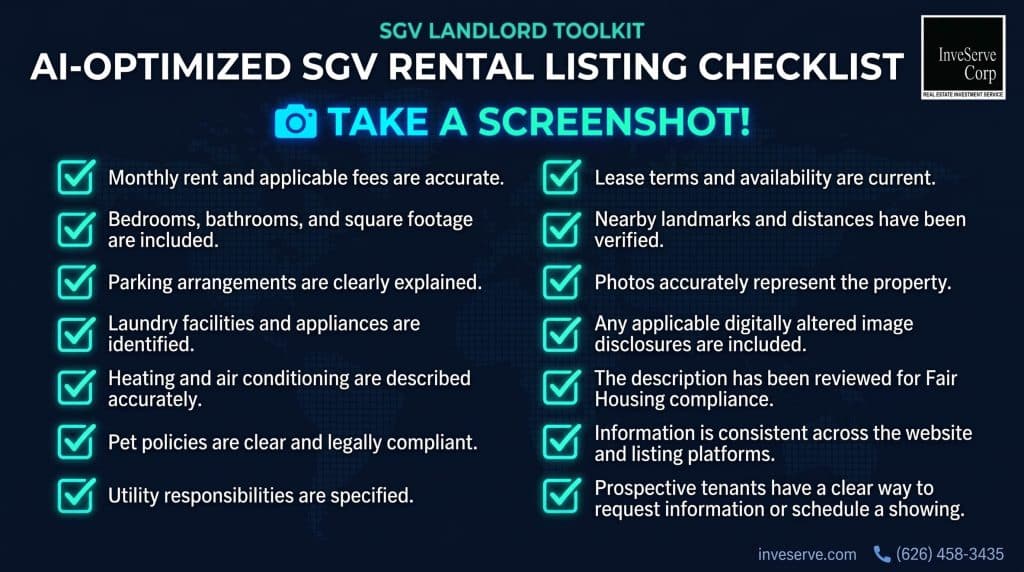
AI-Optimized SGV Rental Listing Checklist
Before publishing a rental advertisement for your San Gabriel Valley investment property, review the following:
- Monthly rent and applicable fees are accurate.
- Bedrooms, bathrooms, and square footage are included.
- Parking arrangements are clearly explained.
- Laundry facilities and appliances are identified.
- Heating and air conditioning are described accurately.
- Pet policies are clear and legally compliant.
- Utility responsibilities are specified.
- Lease terms and availability are current.
- Nearby landmarks and distances have been verified.
- Photos accurately represent the property.
- Any applicable digitally altered image disclosures are included.
- The description has been reviewed for Fair Housing compliance.
- Information is consistent across the website and listing platforms.
- Prospective tenants have a clear way to request information or schedule a showing.
The Future of Rental Marketing in the San Gabriel Valley
The way renters discover available properties will continue to evolve, but the fundamentals of effective rental marketing remain the same.
People want accurate information, appealing photographs, competitive pricing, and a clear understanding of what a property offers.
Google and AI-powered search tools are adding new ways for renters to discover and compare properties. Landlords who provide detailed, accurate, and consistent information are better positioned to serve those renters regardless of which search method they use.
For San Gabriel Valley property owners, the best approach isn’t to chase every new AI marketing trend. It’s to maintain high-quality rental listings, provide useful property information, and make sure prospective tenants can easily find what they’re looking for.
Need Help Marketing Your San Gabriel Valley Rental Property?
InveServe has been helping property owners throughout the San Gabriel Valley since 1989. Our team understands the local rental market and can help you price, advertise, and manage your investment.
Request a free rental analysis to find out what your property could rent for and how professional property management can help you maximize its potential.
Additional Resources
For more information about online search visibility, rental advertising, and applicable housing regulations, consult these resources:
- Google Search Central: AI Features and Your Website
- Google Search Central: Creating Helpful, Reliable, People-First Content
- Google Business Profile: Guidelines for Representing Your Business
- California Department of Real Estate: 2026 Real Estate-Related Legislation
- Federal Fair Housing Regulations: 24 CFR § 100.75